The docks of Hobart were quiet that afternoon as we boarded the ship. The small Tasmanian city seemed as calm as it always does, but a light rain had begun to fall and the wind from the Southern Ocean was slowly picking up – perhaps an early hint of the weather that awaited us further south. For almost two years I had been looking forward to this moment. Now, at last, the expedition was beginning. Ahead lay a month at sea, thousands of kilometers across the Southern Ocean, and a route leading deep into some of the most remote waters on Earth. And finally, I was about to set off on one of the longest cruises I had taken so far. The journey would take us toward the vast and largely untouched regions of Antarctica and, along the way, to some of the isolated islands of the French Southern and Antarctic Lands — places that remain among the most remote on the planet. Among them for example are the Kerguelen Islands, often described as one of the most desolate archipelagos on Earth. Luckily, a few of my friends would also be joining the expedition, which made the journey even more special.
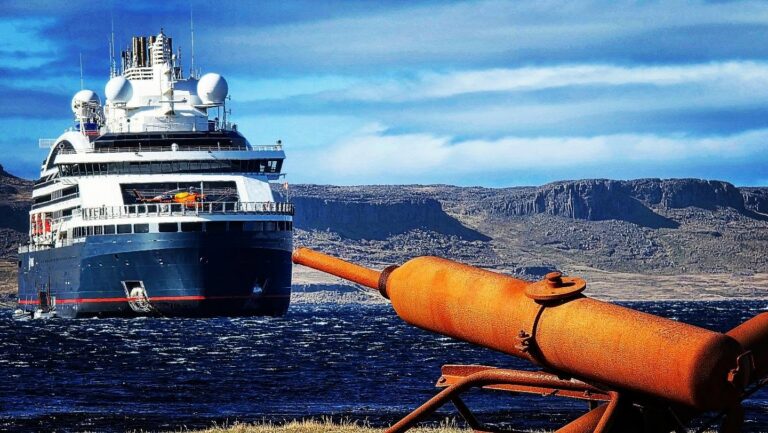
The voyage itself was planned to take a full month aboard Le Commandant Charcot, a very modern and luxurious polar expedition cruise ship sailing under the French flag. Officially registered in Wallis and Futuna, a small French overseas territory in the Pacific, the vessel represents a new generation of polar ships. When Le Commandant Charcot entered service in 2021, it became the world’s first luxury cruise icebreaker, combining the comfort of a high-end cruise ship with the powerful technology required to operate in some of the harshest environments on Earth. Today, the ship is often used for expedition cruises in the Arctic and Antarctica, but it also supports scientific missions. Researchers are sometimes able to travel on board free of charge in order to conduct their work during these voyages.


Le Commandant Charcot surrounded by Antarctic ice
The cruise begins in Hobart, Tasmania in Australia – one of the world’s principal gateways to Antarctica. Standing on the deck, watching the harbor fade behind us, it slowly sank in: after almost two years of waiting, the expedition was finally beginning. From here, the route leads south across the vast expanse of the Southern Ocean toward the frozen edge of the Antarctic continent. These waters are known for their powerful westerly winds and long ocean swells, conditions that have shaped the history of exploration in this part of the world for centuries. As it turned out, the cruise would bring some particularly rough weather for me as well. Waves reaching up to eight metres promised a demanding passage. But with the swell at our backs, the ship seemed less to fight the ocean than to ride it. At times it almost felt as if we were surfing our way toward Antarctica, carried southward by the immense rolling seas. It wasn’t as bad as expected – unfortunately. Part of me had been hoping for a good taste of the Southern Ocean’s famous extremes.

The month-long route of Le Commandant Charcot from Hobart to Cape Town.
The first major landfall on our way lies along the French research outpost Dumont d’Urville Station which sits on a rocky island surrounded by the drifting sea ice, followed by the coast of Wilkes Land, a remote and ice-bound sector of Antarctica rarely visited outside of scientific expeditions. From there, the route follows the Antarctic coastline westward toward Queen Mary Land.
After leaving the Antarctic coast behind, the expedition turns north into the open Southern Ocean. The next destinations are the windswept islands of the subantarctic belt. Among them are the isolated Kerguelen Islands, sometimes called the “Desolation Islands.” Rising from the cold waters of the southern Indian Ocean, they form one of the most remote archipelagos on the planet—an austere landscape of volcanic mountains, glaciers, and treeless tundra.
Further west lie the Crozet Islands, another subantarctic island group known for its immense seabird colonies and vast populations of king penguins. Few places illustrate the raw vitality of the Southern Ocean ecosystem as vividly as these islands. From there, the journey continues across thousands of kilometers of open ocean before finally reaching Cape Town, where the Atlantic and Indian Oceans meet beneath the shadow of Table Mountain. After weeks spent among ice, storms, and some of the most isolated islands on Earth, the arrival in this historic maritime city marks the end of a truly extraordinary passage.

The forecast winds, which proved to be quite manageable on the first leg of the journey to the French Dumont d’Urville Station.

My kingdom for the next month aboard
The first days at sea also offered a welcome opportunity to finally take care of a number of work-related tasks I had been putting off for months. With Antarctica still far away across the vast blue expanse of the Southern Ocean, there was time to settle into life on board and catch up on things that had long been waiting. For the moment, the hours passed as the ship steadily made its way south.

Still a long way to Antarctica
But the real reward came after nightfall. As darkness settled over the Southern Ocean, the sky revealed the first glimpse of one of the southern hemisphere’s most remarkable natural phenomena: the Aurora Australis. For the first time in my life, I was able to witness the southern lights. Crossing the auroral belt gave us a rare chance to see the southern lights in full display. Normally, further south there is simply too much daylight during the Antarctic summer, or the weather prevents any clear view. But on this night the sky opened just enough. The aurora was clearly visible to the naked eye, faint yet unmistakable as it moved across the southern sky – although, as always, it appeared even more striking in photographs.


During the time on board, I also began to get to know some of my fellow passengers. Among them were several “country collectors,” people who, like me, enjoy visiting and collecting different regions and territories around the world. One evening we had a particularly nice gala dinner together. It was a rather unusual table: everyone sitting there had already been to places as remote as Pitcairn Island, for example.
It was also great to finally meet Michael Runkel in person aboard the ship. In a way, he could be considered my main “competitor” in the German travel rankings – although I am about twenty to forty years younger than most of the others in that circle. During our conversation we discovered something interesting: we had both been inspired as children by the same books to explore the world. The stories of Karl May, with his invented adventures of Kara Ben Nemsi — also known as Old Shatterhand — had sparked our fascination with distant places from an early age.

Our Gala Dinner, together with fellow country-collectors
On the fifth day of our journey, we finally approached our first destination in Antarctica. At 6:30 in the morning, it was clear that we had arrived – and not only the penguins seemed to know it. Cold winds swept across the icy coastline as we approached the Dumont d’Urville Station, the French research base perched on a small rocky island at the edge of the Antarctic continent (“Adélieland”). The station lies in one of the most wind-exposed regions of Antarctica, where an incredible wind speed of 327 km/h was recorded – the highest ever measured on the continent. Yes, threehundredandtwentyseven km/h! These powerful winds are known as katabatic winds – cold, dense air flowing down from the Antarctic plateau toward the coast, and sometimes accelerating to hurricane strength.


It was also at Dumont d’Urville Station that we had a rare encounter with another vessel: L’Astrolabe, the French icebreaker responsible for supplying the station.Unlike expedition cruise ships, L’Astrolabe is a true workhorse of the Antarctic. Operated by the French Polar Institute, the vessel regularly sails between Tasmania and the Antarctic coast to deliver fuel, food, scientific equipment, and personnel to the remote research base. Because access to Dumont d’Urville is extremely difficult and sea ice conditions can change rapidly, these supply missions are critical for keeping the station operational throughout the year.
Seeing L’Astrolabe alongside us was therefore a rare sight — a reminder that beyond the world of expedition travel, Antarctica still depends on a small fleet of rugged ice-strengthened ships that keep its scientific outposts alive.

L’Astrolabe resupplying Dumont-d’Urville-Station

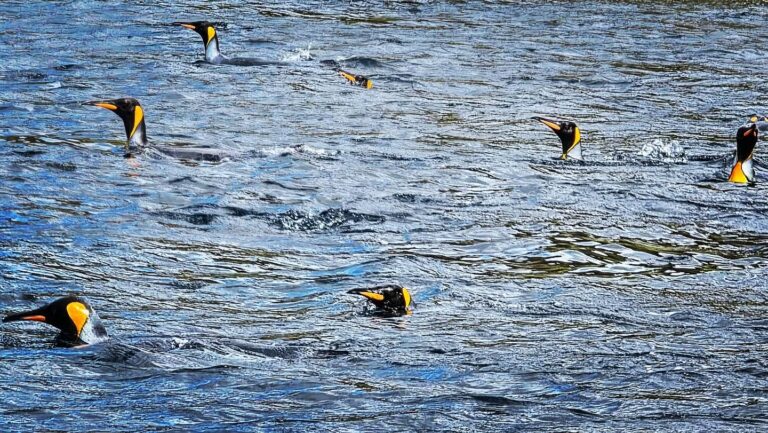
It was also on that same day that we encountered our first penguin colony...

…and other companions that call Antarctica home

A lone seal in front of the towering 40-metre ice cliffs of the Mertz Glacier, Antarctica
The next day marked another milestone – the “bipolar” version of the polar lights. The North Pole will follow in 2027 – already booked – but on this voyage I was finally able to reach the Magnetic South Pole, after having visited the Geographic South Pole back in January 2023. Unlike the geographic pole, which lies deep in the Antarctic interior, the magnetic south pole is not a fixed place. It constantly moves as Earth’s magnetic field shifts, driven by complex processes in the planet’s molten outer core. In fact, the pole currently lies in the Southern Ocean off the coast of East Antarctica, between Adélieland and Wilkes Land, with no land in sight. Standing on deck, somewhere above that invisible point in the ocean, felt strangely symbolic. There was nothing to mark the location – no flag, no station, not even ice – just the endless sea and sky.


Our next destination was already almost within reach as we continued westward along the Antarctic coast toward one of the most remote regions of the entire continent: Wilkes Land. This vast sector of East Antarctica lies just west of Adélieland and stretches for hundreds of kilometers along the frozen coastline. Even by Antarctic standards, it remains one of the least visited parts of the continent. Wilkes Land was first charted during the United States Exploring Expedition of the early 1840s and was later named after the American naval officer Charles Wilkes, who led the expedition and mapped large sections of the Antarctic coastline.
Few tourist expeditions ever reach this remote stretch of Antarctica. The region is known for its extreme weather conditions, powerful katabatic winds descending from the Antarctic plateau, and vast coastal ecosystems that serve as important breeding grounds for penguins and seabirds. Towering glaciers and dynamic ice shelves dominate the landscape, constantly reshaping the coastline. Most Antarctic voyages focus on the far more accessible Antarctic Peninsula, making this route along the coast of East Antarctica a far rarer journey.

Yet Wilkes Land also holds one of the most intriguing geological mysteries on Earth. Hidden beneath the thick Antarctic ice sheet lies a massive structure known as the Wilkes Land Crater. Scientists believe it may be the remains of an enormous meteorite impact, possibly more than 480 kilometers in diameter — making it one of the largest impact structures ever discovered on our planet. The coastline here is shaped by immense glaciers flowing into the Southern Ocean, among them the impressive Mertz Glacier, that you’ve seen already.

It was in Wilkes Land where I was finally able to step off the ship again.


The first stretch of the journey had already taken us thousands of kilometers across the Southern Ocean, from Tasmania to the remote coast of East Antarctica. In just a few days we had experienced powerful storms, our first landings on the frozen continent, and encounters with some of the wildlife that call this harsh environment home. Much of the voyage still lays ahead though – through more remote waters, toward isolated subantarctic islands and eventually across the vast expanse of the Southern Ocean toward Africa.
In the next part of the story, the journey continues.